

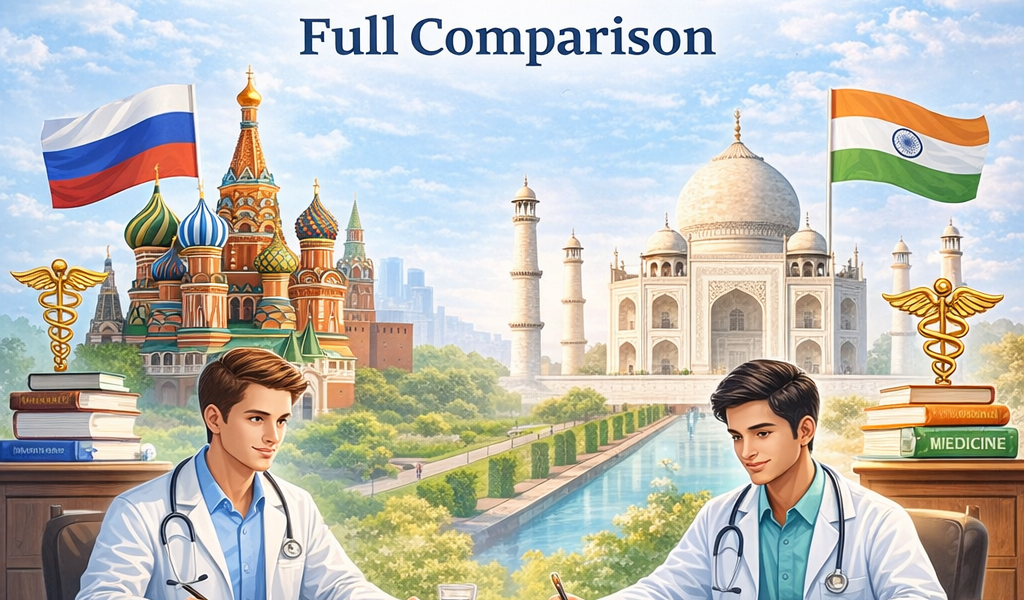
MBBS in Russia vs MBBS in India
Choosing where to pursue your MBBS is one of the biggest decisions for aspiring doctors in India. With rising competition and high fees in medical colleges in India, many students are exploring MBBS abroad, especially MBBS in Russia. This comprehensive comparison guide will help you understand the key differences between MBBS in Russia vs MBBS in India, including admission process, fees, recognition, exams, safety, quality of education, and career prospects.
Whether you scored above or below the cutoff in NEET, this article breaks down everything you must know before making a decision.
1. Overview: MBBS in India and MBBS in Russia
MBBS in India
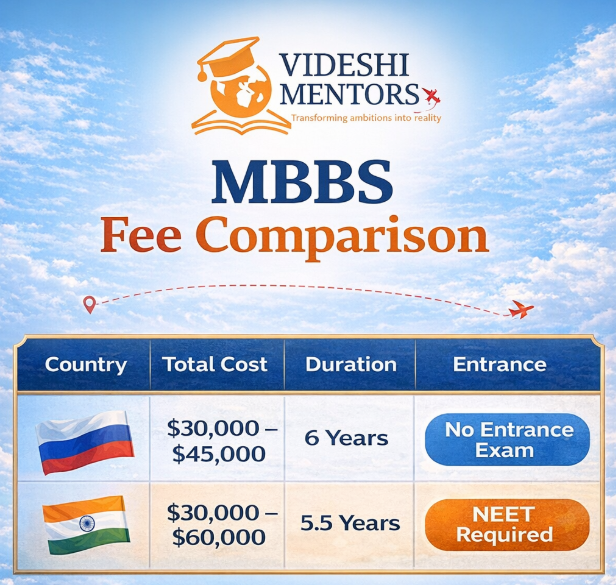
Duration: 5.5 years (including 1 year internship)
Language: English / Regional language (for clinical postings)
Entrance exam: NEET UG (mandatory for all)
Recognized by: NMC (National Medical Commission)
Competitive seats due to high demand
MBBS in Russia
Duration: 6 years (including practical training)
Language: English for medical classes; Russian for clinical rotations
Entrance exam: NEET UG (qualify required but no entrance exam for Russia)
Recognized by: NMC (must clear FMGE/NExT to practice in India)
Affordable options with quality facilities
2. NEET Eligibility & Admission Process
MBBS in India
To get admission:
Qualify NEET UG
Participate in MEDICAL COUNSELLING COMMITTEE (MCC) / state counseling
Get seat in government or private college
Cutoff scores vary every year and competition is extremely high.
Relevant Keywords:
NEET eligibility for MBBS in India
MBBS India admission process
MBBS in Russia
To study MBBS in Russia:
Qualify NEET UG (mandatory for all Indian students)
Apply through university or authorized consultancy
Submit academic documents, passport, and medical clearance
Visa processing (student visa)
No separate entrance test like AIIMS or JIPMER is required for Russia.
3. Tuition Fees & Cost Comparison
Tuition Fees (Approximate Annual Cost)
MBBS in India Fees
| Type of College | Approx. Fees (Total) |
|---|---|
| Government MBBS | ₹1 lakh – ₹10 lakh |
| Private MBBS | ₹20 lakh – ₹1.5 crore+ |
Note: Some private colleges charge high donation fees and additional charges.
MBBS in Russia Fees
| Cost Component | Approx. Amount |
|---|---|
| Tuition Fees | ₹15 lakh – ₹30 lakh (total) |
| Hostel + Food | ₹3 lakh – ₹6 lakh |
| Total (6 years) | ₹18 lakh – ₹36 lakh |
Key Insight:
Even with living expenses included, MBBS in Russia is significantly more affordable than many private colleges in India.
4. Quality of Education & Curriculum
India
Strong foundation in clinical exposure
NMC syllabus + Indian patient population experience
Internship mandatory in Indian hospitals
Russia
Modern labs, advanced medical equipment
Emphasis on scientific research
English-medium programs available
Clinical rotations may require basic Russian proficiency
5. Recognition & Practice Rights
India
After MBBS in India, graduates can register directly with NMC and begin practice.
Russia
MBBS degree is recognized by NMC, but you must clear the FMGE/NExT exam to practice in India.
FMGE/NExT Pass Rates:
Indian MBBS graduates are familiar with the pattern
Students studying abroad should prepare specifically for the exam
6. Language & Cultural Adaptation
India
No language barrier for Indian students
Familiar culture, food, and environment
Russia
Courses are in English, but clinical rotations often require Russian
Cultural adaptation is essential
International student community support
7. Safety & Student Support
India
Strong support systems; far from home for some students
Russia
Modern cities with international student support
Many universities provide 24×7 assistance
Safety training and orientation programs provided
8. Career Prospects After Graduation
In India
Direct practice after internship
Options: PG entrance (NEET-PG), clinical practice, research
After Russia
Clear FMGE/NExT → Practice in India
Opportunity for postgraduate studies abroad
Higher chances for specialization abroad
9. Pros & Cons at a Glance
| Factor | MBBS India | MBBS Russia |
|---|---|---|
| Cost | High in private colleges | Relatively low |
| Competition | Very high | Moderate |
| Recognition | Direct | NExT/FMGE required |
| Language | English / Regional | English + Russian |
| Exposure | India patient base | Global exposure |
Success Stories from Indian Students
From Small Town to MBBS in Russia
Rahul Sharma, from Uttar Pradesh, struggled with NEET but secured admission to Kazan Federal University in Russia. Today, he is completing his clinical training and preparing for FMGE to practice in India.
Achieving Dreams in Kazakhstan
Priya Reddy from Telangana chose Kazakhstan due to affordability. With quality education at Al-Farabi Kazakh National University, she is now excelling in her medical studies and planning to specialize in cardiology.
A New Beginning in Uzbekistan
Amit Patel, after multiple attempts at NEET, opted for MBBS in Uzbekistan. With strong practical exposure, he is confident in clearing NEXT and practicing as a doctor in India.
Conclusion:
Choose MBBS in India if you have high NEET scores and want direct practice without licensing exams.
Choose MBBS in Russia if affordability, quality education, and global exposure matter more, and you are ready to prepare for FMGE/NExT on return.
Both paths lead to becoming a doctor — but your goals, budget, NEET score, and readiness to adapt should guide the decision.
Is NEET mandatory for MBBS in Russia?
Yes, NEET qualification is required for Indian students to go abroad for MBBS.
What is the total cost of MBBS in Russia?
Approx. ₹18 lakh – ₹36 lakh for 6 years.
Can I practice in India after MBBS in Russia?
Yes — after clearing FMGE/NExT exam and registering with NMC.
Does Russia provide English-medium MBBS?
Yes, many universities offer English-taught programs.
Is MBBS in Russia valid in India?
Yes. MBBS degrees from universities listed by the National Medical Commission are valid. However, graduates must clear the FMGE (soon replaced by NExT) to practice in India.
What is the FMGE pass rate for MBBS in Russia?
FMGE pass rates vary by university and student preparation. Students who begin preparation early and follow Indian exam patterns tend to perform better.
Can I do PG in India after MBBS in Russia?
Yes. After clearing FMGE/NExT and registering with NMC, students can appear for NEET-PG or other postgraduate entrance exams in India.
What are the disadvantages of MBBS in Russia?
Need to learn basic Russian for clinical interaction
FMGE/NExT licensing requirement
Weather adjustment
Self-discipline required for exam preparation
Which is better: MBBS in Russia or MBBS in India?
It depends on:
NEET score
Budget
Career goals
Willingness to clear licensing exams
Government MBBS in India is ideal if you secure a seat. Otherwise, Russia is a practical alternative.
Is MBBS in Russia safe for Indian students?
Most major Russian universities have international student support, secure hostels, and structured academic environments. Students should always choose NMC-approved institutions.