

MS in USA
Why Pursue an MS in the USA?
The United States continues to be one of the top choices for international students looking to pursue a Master of Science (MS) degree. With its cutting-edge research facilities, globally recognized institutions, and diverse academic programs, the USA provides a platform for career growth and a bright future.
Whether you’re interested in computer science, engineering, data science, or business management, an MS degree from the USA can open doors to a world of opportunities.
Top Reasons to Study MS in the USA:
World-Class Universities
The USA is home to some of the best universities globally, including institutions like MIT, Stanford University, Harvard University, and UC Berkeley.
Flexible Duration & Programs
Most MS programs in the USA typically last 2 years but offer flexibility to suit individual schedules, including part-time options.
High-Quality Education & Research
US universities are known for their research-driven education system, where students are encouraged to innovate and engage in hands-on learning.
Post-Graduation Work Opportunities
The Optional Practical Training (OPT) program allows international students to stay and work in the USA for up to 3 years in their field of study, depending on the program.
The H1-B visa also offers opportunities for long-term work in the USA.
Financial Aid & Scholarships
US universities offer a wide range of scholarships, assistantships, and fellowships to international students, easing financial burdens.
General Information About the USA 🇺🇸
Capital: Washington D.C.
Currency: US Dollar (USD)
Official Language: English
Weather:
Winters: Varies from -5°C to 15°C, depending on the state
Summers: 20°C to 35°C, with regional differences
Rainfall: Varies; frequent in coastal areas
Time Zone: Varies (Eastern Time, Central Time, Pacific Time, etc.)
Major Airports:
John F. Kennedy (NYC)
Los Angeles International Airport (LAX)
Chicago O’Hare (ORD)
San Francisco International (SFO)
Transport System: Well-developed public transport system in major cities, including metros, buses, and regional trains.

Top Universities for MS in the USA
Here’s a list of top universities that offer world-renowned MS programs:
Massachusetts Institute of Technology (MIT)
Location: Cambridge, Massachusetts
Ranked #1 for Engineering, Computer Science, and Technology
Top Programs: Computer Science, Engineering, Data Science, AI
Stanford University
Location: Stanford, California
Top Programs: Business, AI, Data Science, Biotechnology, Engineering
Harvard University
Location: Cambridge, Massachusetts
Top Programs: Computer Science, Biotechnology, Business Analytics
University of California, Berkeley
Location: Berkeley, California
Top Programs: Engineering, Environmental Science, Computer Science
California Institute of Technology (Caltech)
Location: Pasadena, California
Top Programs: Engineering, Physics, AI, Robotics
University of Illinois Urbana-Champaign
Location: Urbana-Champaign, Illinois
Top Programs: Electrical Engineering, Computer Science, Business Analytics

Popular MS Programs in the USA
The USA offers a variety of programs tailored to industries with high demand for skilled professionals:
Computer Science & Artificial Intelligence
Data Science & Analytics
Engineering (Electrical, Mechanical, Civil, etc.)
Business & Management (MBA, Finance, Marketing)
Biomedical Sciences & Healthcare
Finance & Economics
Environmental Science & Sustainability
Admission Requirements for MS in the USA
Academic Requirements
Bachelor’s Degree: A recognized undergraduate degree in a relevant field.
Minimum GPA: 3.0 to 4.0 scale (varies by program and university).
📝 Standardized Tests
GRE: Some programs (especially in STEM fields) require a GRE score, though many universities have recently made this optional.
GMAT: For students applying to MBA programs.
🌐 English Language Proficiency
TOEFL/IELTS: Minimum IELTS score of 6.5–7.0 or TOEFL score of 80–100.
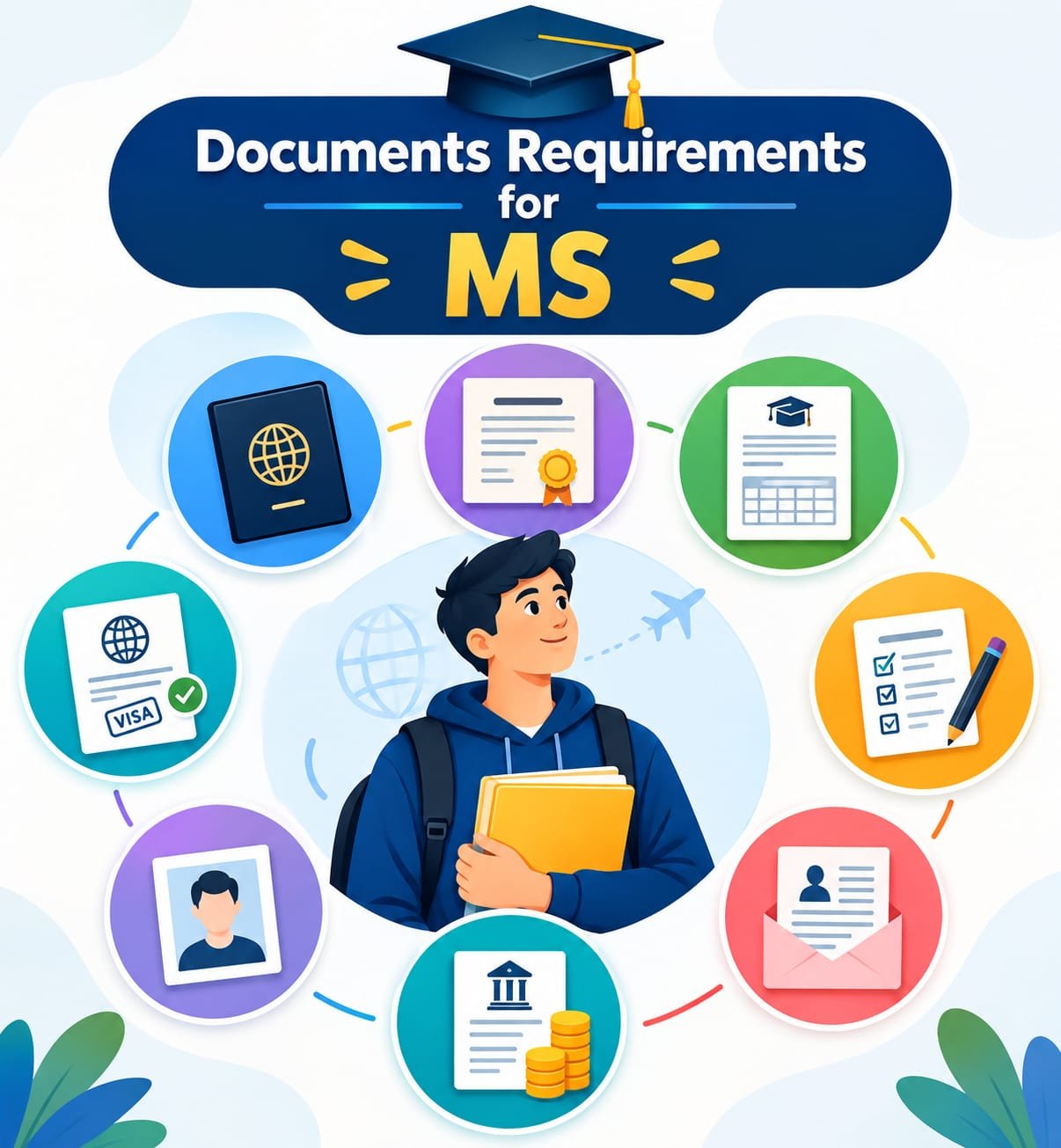
✉ Documents
Statement of Purpose (SOP): A compelling personal statement explaining your motivations, goals, and why you’re a good fit for the program.
Letters of Recommendation (LORs): Usually 2–3 academic or professional references.
Safety and Student Support in the USA
The USA is home to a diverse international student community, and universities offer several safety measures:
24/7 Campus Security: Most universities have dedicated security teams for students’ safety.
International Student Support: Advisors assist with visa issues, housing, and career counseling.
Healthcare & Insurance: Students are required to have health insurance and can access university health services.
Cost of Studying MS in the USA
While studying in the USA offers excellent quality, it can be expensive. Here's an overview of typical costs:
Tuition Fees: Ranges between $20,000 to $60,000 per year, depending on the university and program.
Living Expenses: Around $10,000 to $20,000 per year, depending on the location (major cities are costlier).
Scholarships & Financial Aid: A variety of financial aid options are available for international students.
Student Life in the USA
Studying in the USA offers an incredible experience beyond academics:
World-Class Campus Facilities: From research labs to sports complexes and student unions, US campuses are equipped to offer a balanced lifestyle.
Cultural Diversity: Students from all over the world, creating a global campus experience.
Work Opportunities: Students can work up to 20 hours per week during the academic term and full-time during vacations.
Career Development Services: Universities offer career counseling, job fairs, and internship opportunities, leading to strong employment prospects after graduation.
Admission Process for MS in the USA
The admission process for an MS program in the USA can be complex, but with proper planning, it can be straightforward. Below is a step-by-step guide to help you navigate through the process.
Step 1: Research and Shortlist Universities
Identify your interests: Choose a field that aligns with your academic background and career goals (e.g., Computer Science, Engineering, Data Science, etc.).
Shortlist universities: Research universities that offer strong programs in your chosen field. Consider factors like location, tuition fees, faculty, research opportunities, and ranking.
Step 2: Meet Eligibility Requirements
Bachelor’s degree: Ensure you have a recognized undergraduate degree (usually 3–4 years of study).
GPA requirements: Most universities have a minimum GPA of 3.0 (on a 4.0 scale) for graduate admissions. However, this can vary by program.
Standardized test scores: Some universities require GRE scores for MS programs (especially for STEM fields), but many are moving to GRE-optional policies. For business programs, the GMAT is required.
English proficiency tests: Submit your TOEFL or IELTS scores (minimum scores typically range from 80 to 100 for TOEFL, and 6.5 to 7.0 for IELTS).
Step 3: Prepare and Submit Required Documents
Statement of Purpose (SOP): Write a compelling SOP that explains your motivations for pursuing an MS, your academic interests, and why you’ve chosen the specific university/program.
Letters of Recommendation (LORs): Most universities ask for 2–3 LORs from academic or professional references.
Transcripts & Certificates: Submit your academic transcripts, including your undergraduate marks and degree certificates.
Resume/Curriculum Vitae (CV): Include details of any academic achievements, research projects, internships, and work experience.
Step 4: Submit Your Application
Online Application: Most universities have an online portal for applications. Complete the application form and upload all required documents (SOP, LORs, transcripts, test scores).
Application Fees: Pay the application fee (typically $50–$150) for each university.
Step 5: Interview (If Applicable)
Some universities or programs may conduct an interview as part of the selection process. This is more common for competitive programs like business or engineering.
Prepare to discuss your academic background, research interests, and why you want to pursue your chosen field.
Step 6: Await Admission Decision
After submitting your application, wait for the admission decision. This may take anywhere from 4 to 8 weeks, depending on the university’s processing times.
Step 7: Receive Offer Letter & Accept Admission
If accepted, you’ll receive an Offer of Admission or I-20 form (which is required for your student visa application).
Accept the offer and confirm your place in the program by following the university's instructions.
Step 8: Apply for a Student Visa (F-1 Visa)
- After receiving your I-20, you can apply for a student visa (F-1 visa) at the nearest US embassy or consulate.
- You’ll need to:
- Pay the SEVIS Fee.
- Schedule a visa interview.
- Provide necessary documents such as your I-20, passport, visa application form (DS-160), financial proof (showing that you can cover tuition and living expenses), and visa fee.
Step 9: Financial Planning & Scholarships
Scholarships & Financial Aid: Apply for any available scholarships, assistantships, or fellowships. Many universities offer merit-based scholarships and financial aid to international students.
Plan Your Finances: Estimate tuition, living costs, insurance, and other expenses. Arrange for funding through personal savings, student loans, or scholarships.
Step 10: Pre-Departure & Orientation
Arrange Housing: Decide whether you’ll live in university dormitories or private housing.
Pre-Departure Orientation: Many universities offer pre-departure orientations to help students prepare for their arrival in the USA.
Flight & Travel: Book your flight and get ready to travel to your chosen university.
Step 11: Arrival in the USA
- Upon arrival, attend the international student orientation hosted by your university to get familiar with the campus, visa regulations, and support services available to you.
- Register with SEVIS and complete any necessary paperwork upon arrival.
Post-Graduation Work Opportunities & PR Pathways
Optional Practical Training (OPT)
Students in STEM programs can stay and work in the USA for up to 3 years after graduation.
Non-STEM graduates can apply for a 1-year work extension.
H1-B Visa & Employer Sponsorships
The H1-B visa allows international students to stay in the USA for long-term work opportunities, with employer sponsorship.
Path to Permanent Residency (PR)
After gaining work experience, students can transition to a Green Card and permanent residency through employer sponsorship or investment.
Frequently Asked Questions (FAQs)
At Videshi Mentors, we make your journey to pursuing an MS in the UK smooth and hassle-free. Our expert team is available 24/7 to assist you at every step, from choosing the right university to settling in the UK. Here’s how we guide you through the entire process:
How long does it take to complete an MS in the USA?
Most MS programs last 2 years.
What is the cost of studying MS in the USA?
Tuition fees typically range from $20,000 to $60,000 per year, plus living expenses.
Can I work while studying in the USA?
Yes, students can work 20 hours per week during term time and full-time during holidays.
What is OPT and how long can I work after my MS in the USA?
The OPT program allows you to work in the USA for up to 1 year, or up to 3 years for STEM graduates.
Are scholarships available for international students?
Yes, many universities and private organizations offer scholarships for international students.
What are the English language requirements for studying MS in the USA?
Most universities require a minimum IELTS score of 6.5-7.0 or TOEFL score of 80-100 for MS programs. Some universities may accept other tests like Duolingo or PTE as well.
Is it possible to get a scholarship for my MS in the USA without an outstanding GPA?
Yes, scholarships in the USA are not solely based on GPA. Many universities also consider factors such as research experience, extracurricular activities, and recommendation letters.
Can I apply for an MS program in the USA if I don't have a background in the field?
Some universities offer bridge programs or pre-master’s courses for students transitioning from different fields. It’s best to check with the specific university to understand their requirements.
How difficult is it to get a student visa for the USA?
The process is generally straightforward if you have the necessary documents (admission letter, financial proof, etc.). The F-1 student visa is the most common type for MS students.
What is the job market like for MS graduates in the USA?
The job market for MS graduates in the USA is strong, particularly in fields like data science, engineering, and computer science. Many universities have strong industry ties, and OPT provides a pathway for gaining work experience post-graduation.
Why Choose VIDESHI MENTORS for Your MS in the USA?
Personalized Guidance: Expert consultation to choose the right university and program.
Application Support: Assistance with university applications, SOPs, and securing financial aid.
Visa and Travel Assistance: Complete guidance on visa applications and pre-departure preparations.
Post-Arrival Support: Help with settling into life in the USA, including accommodation and orientation.